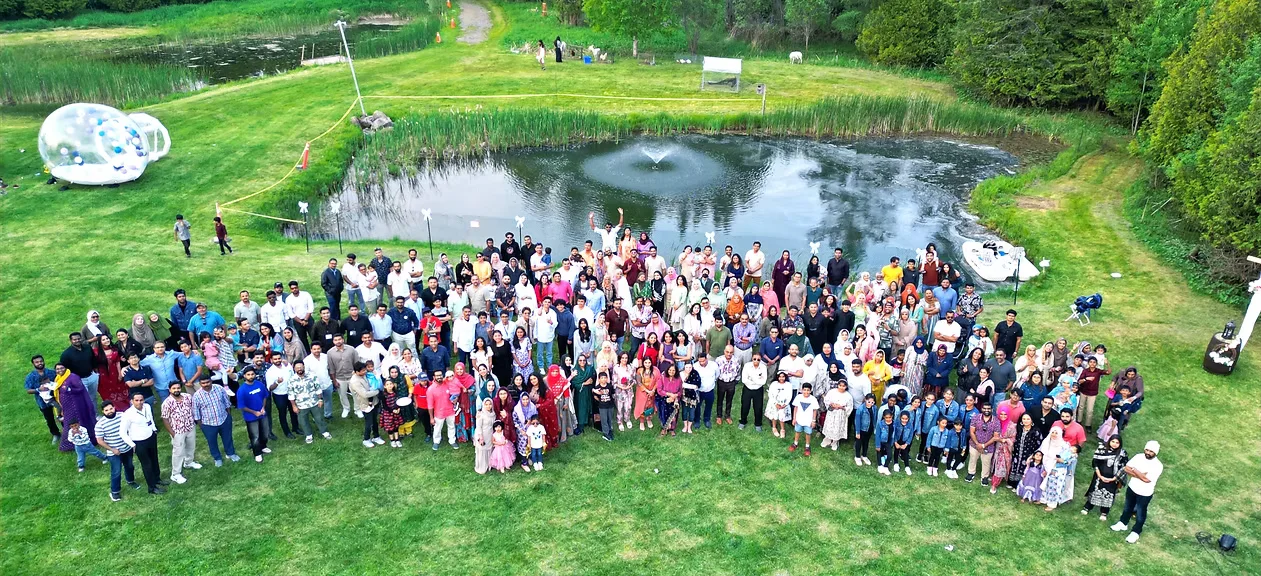
Together for the Greater Good: A Portrait of Kerala Muslim Life in Canada
From the mosque to the biryani pot to the Eid prayer ground: how our community has built a home, and a culture, on Canadian soil.
We come from every corner of Kerala, from the Muslim-majority towns of the Malabar north to the old port cities of Kochi and Kollam, down to the neighbourhoods of Thiruvananthapuram in the south. We speak Malayalam. Most of us are Sunnis of the Shafi'i school, carrying a faith shaped by more than a thousand years of trade and devotion along our coast. Today, in steadily growing numbers, we're also Canadians. Most of us live in and around the Greater Toronto Area, but you'll find our families in Ottawa, Hamilton, Kitchener-Waterloo, London, Windsor, Calgary, Edmonton, and as far out as Surrey on the west coast.
This is the story of the community we're building here: our institutions, our scholars, our food, and the festivals that hold the year together.
Organizations of our own
A community becomes real when it builds places to gather, and ours has done exactly that. Three organizations stand out as the backbone of Malayali Muslim life in Canada. The Malayali Muslim Association of Canada (MMAC) is a registered non-profit whose motto says it plainly: "Together for the Greater Good." MMAC has become a first home for many new arrivals, helping families settle, running youth and professional-development programs, organizing community events, and raising funds for those in need, here and back home. The Merchant Foundation gives our community a place to socialize and find its footing in a new cultural reality, building the everyday connections that turn strangers into neighbours. And The Last Monday, often shortened to TLM, is the Kerala Muslim Students Association in Canada. Named for their gathering on the last Monday of every other month, they help students find jobs, share advice, and build a community of their own while they study far from home.
We don't build in isolation, either. We're woven into the larger fabric of Canadian Islam: praying and learning at the Islamic Institute of Toronto, the Islamic Foundation of Toronto, the mosques and centres of the Muslim Association of Canada (MAC) (which now operates in more than a dozen Canadian cities), and ISNA Canada in Mississauga, whose kitchens serve thousands of free iftar meals each Ramadan. Our children fill their weekend Quran and Arabic classes, and our families pack the Eid prayer halls. And when we want to find one another, whether it's a caterer, a halal butcher, an Onam sadhya, or a Malayali realtor or immigration consultant, Kilikood.ca has become the community's shared address book. It's the largest online directory of Malayali businesses and events in the country.
Our scholars
If you want to see how deep Kerala's roots run in Canadian Islam, look no further than Shaikh Ahmad Kutty. Born in 1946 in Valanchery, Kerala, he trained in the classical Islamic sciences at Islamiyya College in Santapuram and then at the Islamic University of Madinah, before making Canada his home nearly half a century ago. He has served as director of both the Islamic Foundation of Toronto and the Islamic Centre of Toronto, and he sits on the Fiqh Council of North America, the continent's leading body of Islamic law. Today he's the senior resident scholar at the Islamic Institute of Toronto. He has been counted among the world's 500 most influential Muslims, and in 2025 the Muslim Association of Canada honoured him with a Lifetime Achievement Award for fifty years of service. His fatwas have travelled the world, translated into languages from French to Bengali to Malayalam.
There's a quiet pride in this for us. A boy from a Kerala village grew up to help teach a continent how to live as Muslims in the West. He's not alone either: his son, the lawyer and legal scholar Faisal Kutty, has become a respected voice on Muslim civil rights in North America, and our mosques and weekend schools are staffed by many Kerala-trained huffaz, ustads, and volunteer teachers who lead halaqas and deliver khutbas across the country. But Shaikh Kutty is the one we most like to point our children toward. Where we come from is not a limitation. It's a foundation.
The taste of home, on Canadian shelves
Ask any of us what we missed most in the early years, and the answer is almost always the food. That gap has closed fast.
A whole network of Kerala grocers now stocks exactly what our kitchens need: matta rice and the fragrant jeerakasala (kaima) rice for biryani, curry powders, tapioca, banana chips, frozen fish, and the familiar brands we grew up on like Eastern, Brahmins, Double Horse, Saras, and Kitchen Treasures. Royal Kerala Foods has represented Keralam in Toronto since 1996, one of the true pioneers. Motherland Foods serves Scarborough and Brampton. Thanima anchors Mississauga. Babu Smart looks after London. Grocery Basket serves families all the way out in Surrey, British Columbia. And for those far from any storefront, online grocers like KartWheel and Pumpkin Kart ship Kerala staples across the country.
The restaurants that feed us
The kitchens have followed the grocers, and today a Malayali can eat their way across Canada without ever leaving Kerala's flavours behind.
At Kerala Kafe in Scarborough, the menu reads like a homesick heart's wish list: Malabar dum biryani, porotta and beef fry, fish curry with kappa. Cafe Tea Talks, also in Scarborough, has built its own following around Malabar biryani, crispy snacks, and proper chai. Kerala Curry House in Mississauga has become a destination in its own right, famous for a weekend buffet of ninety-plus dishes and an Onam Malabar sadhya served on banana leaves. Malabar Biryani House in Toronto builds its biryani on proper jeerakasala rice, and Ocean Palate, with locations across Brampton, Mississauga, Cambridge, Barrie, and Hamilton, brings coastal dishes like chatti choru to five cities at once. Thanima Kerala Kitchen and Taste of Malayalee's blur the line between grocer and kitchen, selling both the ingredients and the finished meal. Out west, Malayali-run kitchens in Edmonton and beyond do the same.
It's worth saying plainly that most of these grocers and restaurants serve all Malayalis, not only Muslims. They're a gift we share with our Hindu and Christian Kerala neighbours, and much of the menu is proudly common ground. But the Malabar biryani, the beef fry, the halal-marked kitchens carry a particular weight for us. They're how our own food culture survives the crossing. Long after the Malayalam gets shaky in our children, the biryani pot still comes out on the weekend.
Ramadan and the two Eids
Our year bends around the same sacred days it always has, only under a different sky. Ramadan in Canada can mean fasting through the long light of a northern summer or the short grey afternoons of winter. Either way, each sunset the community comes together to break the fast: at home, at the mosque, at the great communal iftars that GTA Islamic centres open to everyone, Muslim and non-Muslim alike. Above all, it remains our season of giving, the month when families are most generous and our organizations run their biggest charity and fundraising drives for causes at home and abroad.
Then come the two Eids, Eid al-Fitr at Ramadan's close and Eid al-Adha: mornings of packed prayer halls, new clothes, children clutching Eidi, and tables heavy with biryani, payasam, and every sweet we can manage. For the many families whose parents and grandparents are still in Kerala or the Gulf, these are also days of long video calls across time zones, holding a family together over three continents at once.
A fuller calendar, a fuller community
Around the sacred days runs a rich civic life. There's the shared Malayali calendar we celebrate with all Keralites: the Onam sadhya, that great vegetarian feast on a banana leaf, which our restaurants now recreate every autumn. And there's the steady work of an emerging community: youth nights and sports days, professional networking evenings, matrimonial introductions, back-to-school drives, Eid bazaars, and above all the welcoming of the newest arrivals. It's the volunteer who meets a family at the airport, the WhatsApp group that finds them an apartment, the aunty who drops off a first home-cooked meal. This is what it looks like when a community decides to put down roots rather than merely pass through.
And through all of it runs our care for the next generation. In madrasas and weekend halaqas, in Quran and Arabic classes, and in the Malayalam our children half-resist and half-absorb, we're trying to hand down not just the biryani but the deen, the language, and a sense of where they come from. It's the great work in front of us, and we take it up gladly.
What we are building
We're young here, and still finding our shape. But look at what already stands: organizations of our own, a scholar who commands a continent's respect, grocers and restaurants that have put Kerala on Canadian shelves and Canadian tables, and a calendar of gatherings that turns strangers into neighbours and neighbours into family. From a village in Kerala to a mosque in Mississauga is a very long way to travel, and we've travelled it together, for the greater good.
We carry Kerala with us, all of it, north to south. Now let's make sure our children do too.