The Everyday Etiquette Nobody Explains to Newcomers
Nobody emails you a rulebook when you land. You learn most of it by watching, by a stranger's look, or by getting it wrong once and feeling it. Here's the version somebody should have told you on day one.
Every community that settles somewhere new goes through this stage: the practical, unglamorous work of learning a place's unwritten rules while holding on to everything that makes you who you are. None of what follows asks you to be less Malayali, less Muslim, or less yourself. It's the opposite, really. Knowing the room you're in lets you walk into it with confidence instead of guessing.
The small things that say "I see you"
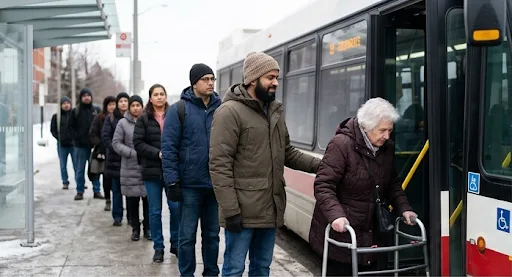
Canadians notice queueing the way Keralites notice a wedding running late. Wait your turn at the grocery till, the pharmacy counter, the bus stop, even if the line looks informal. On transit, let people off before you get on, and if you see a senior or someone with a stroller, the priority seating near the door is genuinely for them, not a suggestion. Hold a door for the person a few steps behind you. Keep phone calls at a volume the whole waiting room doesn't need to hear. None of this is a test. It's just what "I noticed you, and I'm not going to make your day harder" looks like here, and it's read as such.
Sharing air, not just space
This is the one nobody wants to bring up, and everybody notices anyway, so it's worth saying plainly and fairly: a Canadian winter means months of shared indoor air, in offices, in classrooms, on transit, at the masjid. It goes both ways. A shower and fresh clothes before work matter, and so does going easy on the attar or cologne in an elevator or a small meeting room, since a little goes further indoors than it ever did with a Kerala breeze coming through the window. If your cooking clings to a jacket you wore in the kitchen, a quick air-out before you leave the house solves it. This isn't about erasing home from how you smell. It's about noticing that you're now sharing a sealed room with people for eight hours at a stretch, and a little awareness costs nothing.
A few words go a long way
You don't have to be fluent to be understood, and you don't have to stop speaking Malayalam at home to belong here. Keep the language alive with your children; it's one of the best gifts you can hand them. But make the effort to build enough English (or French, depending on where you settle) to talk to your neighbor, sit through a parent-teacher meeting without a translator, or chat with a colleague at lunch. It's the difference between living near a community and living inside one. The confidence comes with repetition, not perfection, and every uncle and aunty in this community remembers fumbling through their first real conversation in English. Nobody here is grading your accent.
Equal footing, not just Kerala manners
Some habits that pass without comment back home land very differently here, and it's worth being upfront about the biggest one: staring, especially at women, or reading ordinary friendliness as something more than it is. Canadian workplaces and public life run on a baseline assumption that men and women are colleagues, classmates, and neighbors on equal footing, full stop, and that assumption doesn't bend for what anyone grew up around. It's a small adjustment in behavior that prevents a much bigger misunderstanding, and it's one of the fastest ways to either earn respect or lose it in a new place.
Leaving the old maps behind
Kerala's social lines- caste, district, sect, political camp- don't need a visa to follow you here, but they're worth leaving at the airport anyway. Our community in Canada is still small enough that every mosque, every WhatsApp group, every Eid gathering works better when it isn't quietly sorted by where in Kerala someone's family is from or which mosque their grandfather attended. Who you hire, who you rent to, who you welcome at the door- none of it should trace back to divisions that made sense in a different country and don't serve anyone in this one. The community that thrives here is the one that decided those old maps no longer mattered.
Respect runs both ways
None of this is about hiding who you are to make someone else comfortable. Our food, our music, our Eid celebrations, the warmth of a Malayali gathering- that's not up for negotiation, and it shouldn't be. What changes is how you carry it into shared spaces: a queue, an office, a classroom, a prayer hall. Every generation of newcomers before you has made the same trade, and it never cost them their identity. It's what let their children grow up proudly Malayali, proudly Muslim, and fully Canadian, all at once. If something in this article doesn't sit right, or you've learned a lesson the hard way that belongs here too, that's exactly the kind of thing worth bringing to the rest of the community, so the next family doesn't have to learn it alone.