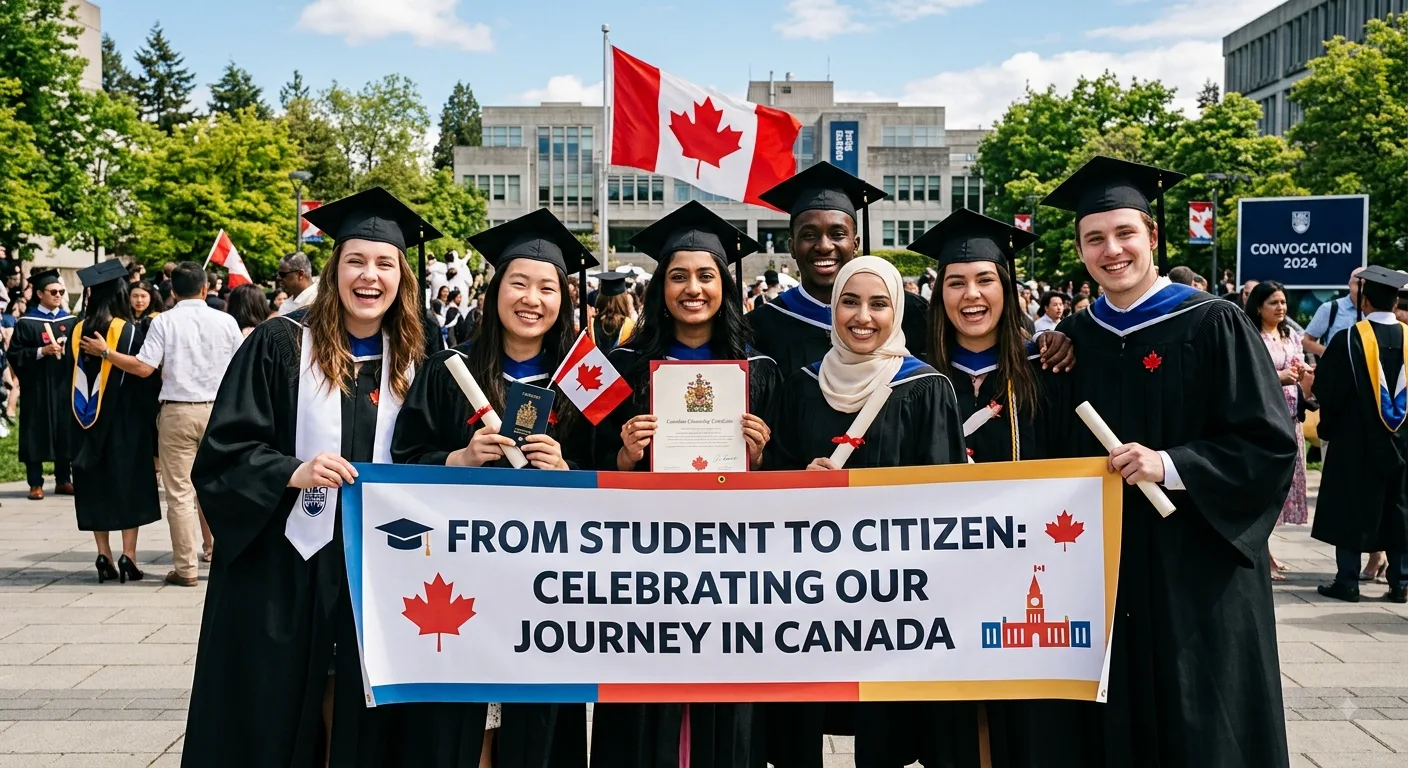
Student to Citizen
Many students who come to Canada from Kerala on a study permit are working toward the same longer goal: a work permit after graduation, some skilled work experience, and eventually permanent residence. This is a guide to how that pathway is put together as of August 2026, whether you have already arrived or are still planning the move.
One thing to settle first. The rules changed substantially in 2024 and 2025, and they continue to move. Advice based on a relative's experience from a few years ago may no longer be accurate. Treat this article as a map of the current structure, and confirm every step against Immigration, Refugees and Citizenship Canada (IRCC) before you act on it, because the specifics can shift within a year.
Step 1: The program has to qualify for a work permit
For non-degree programs, the field of study now affects whether the program leads to a post-graduation work permit (PGWP) at all.
If your study permit application was submitted on or after November 1, 2024, and you are entering a diploma, certificate, or post-graduate certificate program, that program must fall within a PGWP-eligible field of study. IRCC ties eligibility to a list of fields linked to long-term labour shortages, identified by six-digit CIP (Classification of Instructional Programs) codes. If your program is not on the list, you can complete it and still not qualify for a work permit afterward.
A few specifics worth knowing:
Graduates of bachelor's, master's, and doctoral degree programs are exempt from the field-of-study restriction. Any field qualifies for them.
Several college diploma areas that were once common choices, including general business, management, and hospitality, are currently outside the eligible list.
Most programs delivered by private career colleges are no longer PGWP-eligible.
IRCC announced in early 2026 that the eligible field-of-study list will not change for the rest of 2026, so a program on the list today is stable for a 2026 start.
Before accepting an offer, find the program's CIP code and check it against IRCC's current eligible fields list. This is the step most worth doing yourself rather than relying on a recruiter or an agent.
Step 2: The post-graduation work permit
The PGWP is the open work permit that lets you work in Canada after graduating and build the experience that PR programs look for. To qualify, in broad terms, you need to have:
studied full-time in a program of at least eight months at a designated learning institution,
applied within 180 days of receiving confirmation that you completed the program, and
met the language requirement that applies since November 2024: CLB 5 for college graduates, CLB 7 for university graduates.
A practical note on the language test: results expire, and a score you took for admission may no longer be valid when you graduate. Many applications are delayed for this reason, so plan the test date with the PGWP deadline in mind rather than the admission one.
Step 3: Working during and after study
While studying, you can work up to 24 hours per week off campus during academic terms, and full-time during scheduled breaks such as summer and winter holidays. The 24-hour figure is a weekly ceiling, not an average, and exceeding it counts as a study permit violation that can affect later PGWP and PR applications. On-campus work is governed by separate rules.
Once you hold a PGWP, the type of work matters for PR. Most PR pathways for former students count skilled work experience, generally in occupations classified at TEER 0, 1, 2, or 3 under Canada's occupation system. A survival job that does not fall into those categories pays the bills but does not build the experience most economic PR streams require.
Step 4: Applying for permanent residence
This is where a former student's plan meets the wider immigration system, and where the current picture differs most from a few years ago.
Through 2026, IRCC's Express Entry rounds have focused largely on candidates already in Canada, mainly through the Canadian Experience Class (CEC) and French-language categories. There have been no all-program draws this year. For a college graduate with about a year of skilled Canadian work experience and no provincial nomination, the Canadian Experience Class is the usual route. Its cutoff score has sat between roughly 507 and 518 across 2026 rounds, and has not fallen below 507.
Two factors move a candidate's Comprehensive Ranking System (CRS) score more than most:
French. Reaching CLB/NCLC 7 in French adds a significant number of points and opens French-language draws, where cutoffs have run closer to 400 than to the 510-plus of general rounds. It takes a year or more of study, so it is a long lever rather than a quick one.
A provincial nomination (PNP). A nomination adds 600 points, which is why PNP draw cutoffs appear very high (700-plus) without meaning you need that score on your own. The difficulty is securing the nomination. Provincial programs have their own occupation lists and quotas, and several have been cut or restructured. Manitoba, for example, phased out its standalone international-graduate stream in 2026.
Candidates who are not eligible for CEC, a French-language draw, a PNP, or an occupation-based category draw have had few direct routes this year. Because all of these numbers move draw to draw, check IRCC's Express Entry pages for the current rounds rather than relying on a figure you saw quoted somewhere.
The community side of a multi-year process
This pathway usually runs four to six years from landing to PR, most of it spent far from home. Two kinds of community tend to make that stretch more manageable, and both are relevant to the practical steps above.
On campus, MSA National, the Muslim Students Association of the U.S. and Canada, has supported chapters since 1963. Your local chapter is often the quickest route to a prayer space, a worked-out Ramadan schedule, and other Muslim students who understand your week. Check whether your college has a chapter before you arrive.
Within the Malayalee community, The Last Monday is the Muslim Malayalee students' organization in Canada, run by earlier students for those arriving after them. They meet on the last Monday of every other month, and much of what they organize maps onto the steps in this guide: career guidance, job-search and resume help, sessions on settling into a new city, winter preparation, course selection, and programs on mental health and on managing money in Canada. When the plan depends on landing skilled work in your field, a network of Malayalees already working here is directly useful.
The two serve different purposes. An MSA is your day-to-day campus and religious life among Muslims from every background. The Last Monday is the Malayalee-specific network for the practical and personal questions that come with settling in.
For anyone still in the planning stage, the highest-value action is the first one: confirm your program's CIP code against IRCC's eligible list before committing to it. Everything downstream depends on that single check.
A note on accuracy: This article is general information current as of August 2026, and it may contain errors or be out of date by the time you read it. Immigration rules in Canada change often. Nothing here is legal or immigration advice. Before making any decision, check the official Immigration, Refugees and Citizenship Canada (IRCC) website at canada.ca for the current rules, or work with a licensed immigration lawyer or a regulated Canadian immigration consultant (RCIC).